
Buying in ADGM or DIFC? What Changes In Your Mortgage Process and Fees

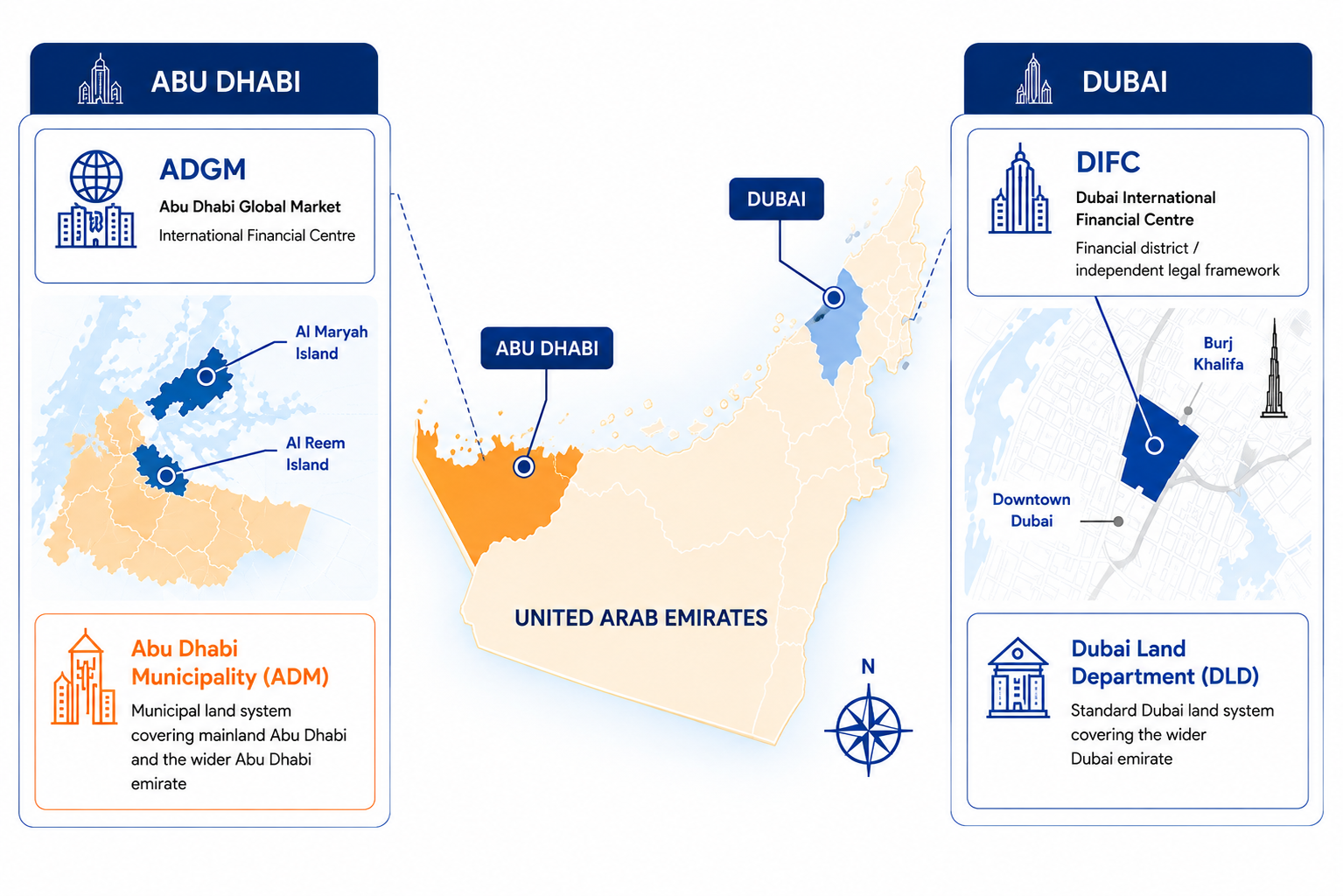
The UAE property market operates under more than one legal and regulatory framework.
Most buyers do not notice this distinction because the majority of properties fall under the standard land registration systems. In Abu Dhabi, this is managed by the Abu Dhabi Municipality (ADM), while in Dubai, it is managed by the Dubai Land Department (DLD). These authorities govern most property transactions across the two emirates.
However, there are two separate jurisdictions that operate outside these standard frameworks. They follow their own legal, registration and regulatory systems, which can make the transaction process quite different.
Key Takeaways
DIFC and ADGM have their own property registries. DIFC uses the Registrar of Real Property. ADGM property services are handled through AccessRP.
The registration authority, documents, fees and lender handling can differ from mainland transactions.
Mortgage eligibility and lending limits still depend on the borrower, property and lender.
Confirm the registry, bank requirements and complete transaction costs before signing or committing to a completion date.
Understanding DIFC and ADGM
In 2002, His Highness Sheikh Mohammed bin Rashid Al Maktoum issued a law formally establishing the Dubai International Financial Centre. DIFC then began operations in 2004 with the opening of The Gate.
Abu Dhabi later introduced its own financial centre. ADGM was established in 2013 and became operational in 2015 on Al Maryah Island. In 2023, its jurisdiction was expanded to include Al Reem Island. ADGM's real property framework applied to Al Reem Island from 1 January 2025. As a result, some older title deeds and property documents may still reference the previous registration authority.
Both zones were created for a similar purpose. The UAE wanted to attract international banks, financial institutions and professional services firms that were more familiar with English common law than the UAE civil law system.
To support this, DIFC and ADGM were each given their own legal framework, their own courts and their own registration authorities.
In simple terms, this means that a dispute arising within DIFC is handled by the DIFC Courts, rather than the Dubai Courts. In the same way, a property located within ADGM is registered through the ADGM Registration Authority, rather than the Abu Dhabi Municipality.
UAE Property Registration Landscape: Mainland vs Financial Free Zones
How mortgage registration differs
In a standard DLD or ADM transaction, the process is well established. Once the offer letter is issued, the bank requires the developer NOC, and the property transfer and mortgage registration are completed together during a single appointment.
DIFC and ADGM follow a different process because each jurisdiction has its own independent property registration authority.
Select the relevant jurisdiction from the cards below to understand how the property is registered and which authority manages the registration process.
Dubai Land Department DLD
Dubai Land Department
The property transfer and mortgage registration are generally completed together during the same appointment, subject to the bank, developer and transaction requirements.
Abu Dhabi Municipality ADM
Abu Dhabi Municipality
The property transfer and mortgage registration are generally completed through the established Abu Dhabi property registration process, subject to the bank and transaction requirements.
Dubai International Financial Centre DIFC
All property registrations within DIFC, including mortgage registrations, are handled by the RoRP. The mortgage receives its own registration number, and the bank’s legal security is completed once the registration has been finalised.
Abu Dhabi Global Market ADGM
ADGM Registration Authority through AccessRP
Property transactions, including sales, purchases, transfers, leases and mortgage registrations, are processed digitally through AccessRP. This covers properties on Al Maryah Island and Al Reem Island.
Comparing the Two Journeys
Understanding how property registration works in these jurisdictions is one of the most important steps a mortgage buyer can take before committing to a purchase.
Below is a simple overview of how the mortgage journey works from start to finish.
Applicable sale and purchase agreement / MOU is signed
⌄Applicable sale and purchase agreement / MOU is signed.
Bank valuation
⌄Bank arranges a valuation with an approved valuer.
Final offer letter and mortgage contract
⌄Bank issues the final offer letter and mortgage contract.
Developer NOC
⌄Developer NOC is obtained.
Title transfer and mortgage registration
⌄In Dubai mainland, the transfer and mortgage registration are completed through the applicable DLD process. In Abu Dhabi mainland, registration follows the relevant Abu Dhabi authority and service procedures, including DARI where applicable.
Applicable sale and purchase agreement / MOU is signed
⌄Applicable sale and purchase agreement / MOU is signed.
Bank valuation
⌄Bank arranges a valuation with an approved valuer.
Final offer letter and mortgage contract
⌄Bank issues the final offer letter and mortgage contract.
Developer NOC
⌄Developer NOC is obtained.
Supporting documents uploaded
⌄Supporting documents are uploaded through the ADGM or DIFC digital portal. extra step
Title transfer and mortgage registration
⌄Title transfer and mortgage registration are completed through the relevant authority, either online or in person.
Documents Commonly Required for Property Transfers
Understanding how property registration works in these jurisdictions is one of the most important steps a mortgage buyer can take before committing to a purchase.
Property Transfer Document Checklist
- ✓ Signed sale and purchase agreement or applicable MOU
- ✓ Identification documents for the buyer and seller
- ✓ Developer or building clearances, where required
- ✓ Bank approval and mortgage documentation
- ✓ Existing mortgage release documents, where applicable
- ✓ Evidence of payments and registration fees
Understanding the Associated Fees
Fees vary across the four frameworks: ADM, ADGM, DIFC, and DLD, depending on your property value and loan amount. FCMB's Associated Fees Calculator provides an illustrative breakdown of these costs across all four frameworks, so you can plan ahead with more clarity.
Property Transfer and Mortgage Registration Fees by Jurisdiction
Property transfer fees and mortgage registration charges differ depending on where the property is registered. The comparison below outlines the main published fees for Dubai mainland, Abu Dhabi mainland, DIFC and ADGM.
| Registry | Transfer Fee and Basis | Fee Responsibility | Mortgage Registration | Additional Charges and VAT |
|---|---|---|---|---|
|
DLD Dubai Mainland |
4% of the property sale value under applicable registration rules. | The published service breakdown identifies 2% for the seller and 2% for the buyer. The parties may agree on a different allocation of costs. | 0.25% of the mortgage value. | Title deed, map, knowledge and innovation fees may apply. Trustee service charges depend on the transaction value and service category. VAT applies to relevant service partner charges. |
|
Abu Dhabi Mainland
ADM / ADREC / DARI |
2% of contract value under the published DARI sale service. The applicable assessment basis depends on the transaction category. | The statutory fee responsibility and agreed buyer/seller cost allocation depend on the applicable transaction and registration rules. |
0.09%
of the mortgage contract value for
DARI's Register Unit Mortgage service.
0.1% for DARI's Register a Property Mortgage Contract service. The applicable rate depends on the registration service used. |
The published mortgage registration services list an electronic administration charge of AED 450, excluding 5% VAT for the Unit Mortgage service. Other registration and service charges may apply. |
|
DIFC Dubai |
5% of the consideration or the Registrar-assessed market value, whichever is higher, subject to the applicable rules and exemptions. | Transfer documentation and payment follow DIFC registration rules. The allocation of costs between the parties should be agreed before completion. | 0.25% of the secured debt. | Other prescribed registration or instrument fees may apply. VAT treatment should be checked for each applicable charge. |
|
ADGM Al Maryah / Al Reem |
2% for the relevant freehold transfer category, subject to the applicable valuation basis and fee schedule. | The transferor is identified as the statutory payer under the published ADGM fee schedule. | 0.1% of the mortgage value under the published fee schedule. | Other prescribed registry charges may apply. Additional service charges and VAT treatment depend on the applicable transaction. |
Official references: DLD Sale Registration | DARI Unit Mortgage | DARI Property Mortgage | DIFC Real Property Regulations | ADGM Fee Schedule
Estimated Associated Fees Calculator
Select your buyer profile and property type, then enter the property value to compare illustrative transfer and mortgage registration charges across ADM, ADGM, DIFC and DLD.
Non-Resident Does not hold a UAE residence visa. Financing depends on the lender.
UAE National / Emirati Citizen of the United Arab Emirates.
Self-Employed Earns income from a business or business ownership.
LTV guidance
LTV limits depend on nationality, property category and the bank's lending policy.
These calculations are approximate and provided for general guidance only. Displayed subtotals include selected published charges, not all transaction costs. Additional registration, administration, trustee, developer, bank, valuation, agency and VAT charges may apply. Eligibility, LTV and loan approval depend on the bank's assessment. DIFC and ADGM may use Registrar-assessed market values that differ from the bank valuation. Off-plan registration procedures and fees may also differ.
How Title Deeds Differ Across DLD, ADM, DIFC and ADGM
The property title deed does not look the same across every jurisdiction. The issuing authority, the layout and the information shown can differ depending on whether the property falls under Dubai Land Department (DLD), Abu Dhabi Municipality / Abu Dhabi Real Estate Centre (ADM / ADREC), DIFC or ADGM.
For mainland Abu Dhabi property transactions, Abu Dhabi Municipality (ADM), Abu Dhabi Real Estate Centre (ADREC) and DARI have different roles. ADREC oversees the real estate sector, while DARI provides digital services for property registration and related transactions. Properties within ADGM follow a separate registration framework, with services available through AccessRP.
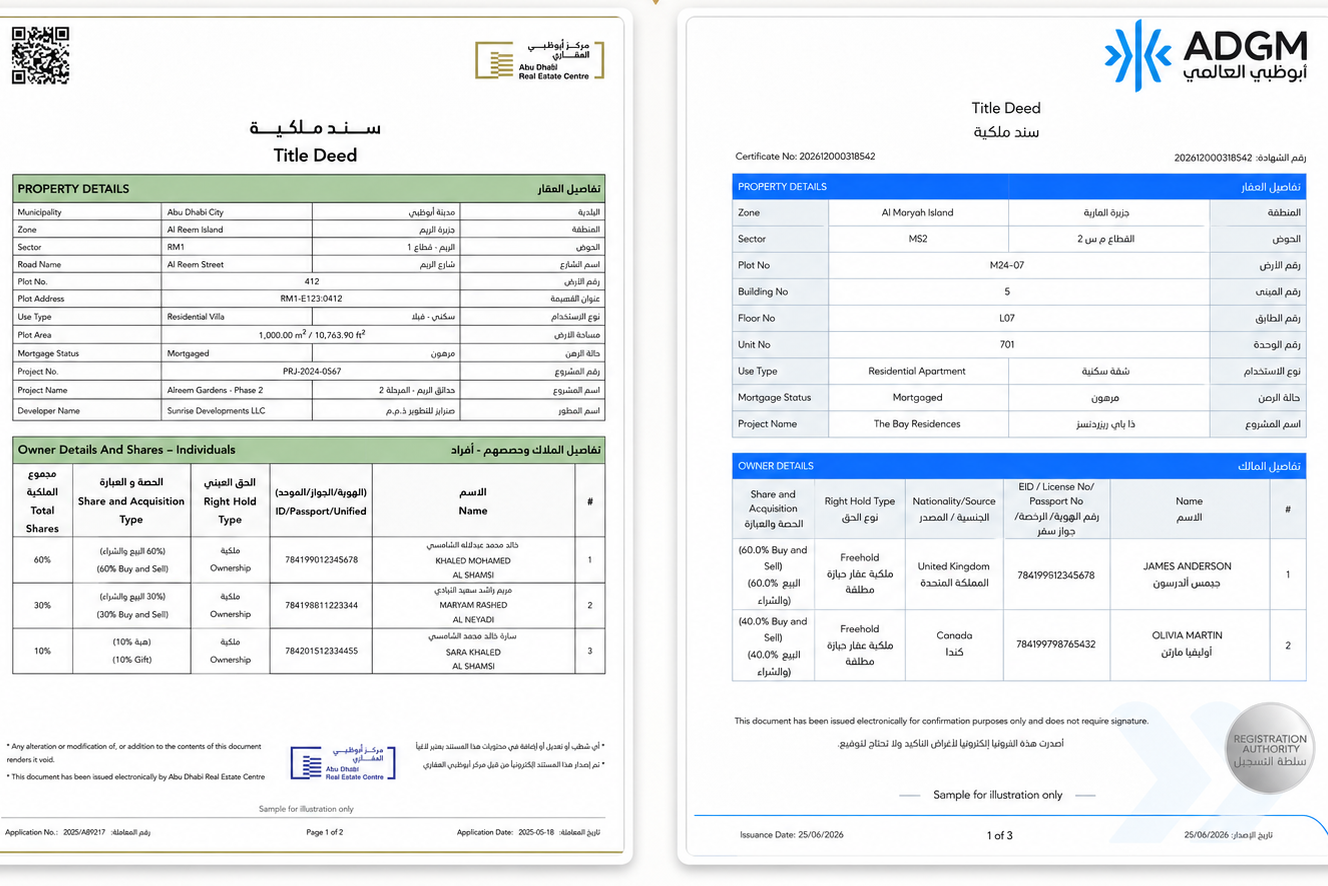
Sample Title Deed of Abu Dhabi Municipality (ADM) Vs Abu Dhabi Global Market (ADGM)
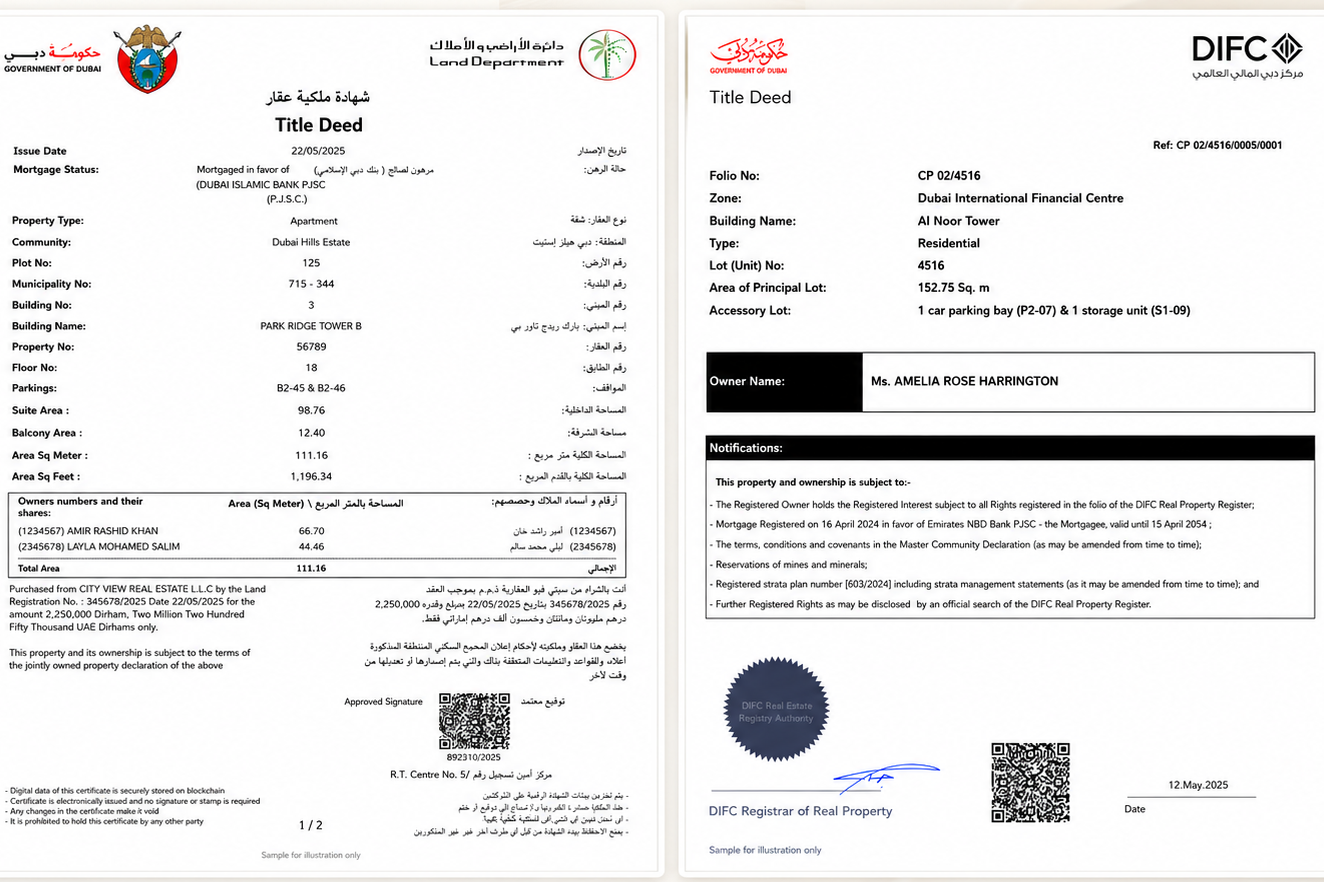
Sample Title Deed of Dubai Land Department (DLD) Vs Dubai International Financial Centre (DIFC)
Frequently Asked Questions About ADGM and DIFC Mortgages
Buying a property in ADGM or DIFC can involve different registration procedures, fees and bank requirements. Here are answers to some common questions.
01 Does the 4% DLD transfer fee apply to DIFC properties?
No. DIFC has its own real property registration framework, separate from the Dubai Land Department (DLD). The standard DIFC freehold transfer fee is generally 5% of the consideration or the Registrar's assessed market value, whichever is higher, subject to the applicable rules and exemptions. Buyers should confirm the registration charges before signing the sale agreement.
02 Are properties on Al Reem Island registered under ADGM or Abu Dhabi mainland?
Al Reem Island became part of ADGM's expanded jurisdiction in 2023, and ADGM's real property framework became applicable to Al Reem Island on 1 January 2025. Some older title documents may still refer to the previous Abu Dhabi registration system. Buyers should confirm the current property registration record and the applicable transfer process before arranging mortgage completion.
03 Which residential buildings in DIFC are eligible for mortgage financing?
Mortgage availability depends on the individual building, the property's registration and the lender's policy. A bank may finance certain residential developments within DIFC but not others. Before committing to a purchase, it is advisable to confirm that the selected property is acceptable to the lender, along with the financing amount and applicable conditions.
04 How long does an ADGM or DIFC mortgage transfer take?
There is no single timeline that applies to every transaction. Completion depends on the bank's mortgage approval, valuation, documentation, any required developer or building clearances, and the relevant registry's processing requirements. DIFC also has specific deadlines for lodging and paying certain transfer fees, which should not be confused with the overall mortgage completion timeline. Buyers should agree on a realistic completion schedule with the bank and other parties involved.
05 Can buyers obtain a mortgage for off-plan properties in ADGM or DIFC?
Off-plan mortgage financing may be available, depending on the lender, developer, project, construction stage and buyer's financial profile. Under the UAE Central Bank's mortgage regulations, the maximum LTV for off-plan property financing is 50%, although banks may apply stricter limits or may not finance a particular project. Buyers should confirm the bank's requirements and financing availability before committing to the developer's payment plan.
How FCMB Helps
At FCMB, we begin by understanding the property, the jurisdiction it falls under, and the registration process that applies. This helps us identify the most suitable banks, structure the mortgage correctly, and address any potential delays from the beginning.
For buyers purchasing within ADGM or DIFC, this early preparation can make a significant difference and help the transaction move more smoothly from application through to final registration.
About the Author
Written by: FCMB Team
Reviewed by: Zamran Zaharan, Founder and Senior Mortgage Broker at First Choice Mortgage Broker (FCMB)
About the Reviewer: With close to two decades of experience in the UAE mortgage industry, Zamran brings extensive knowledge of bank lending policies, mortgage financing and property transactions.
Last Reviewed: 07/11/2026